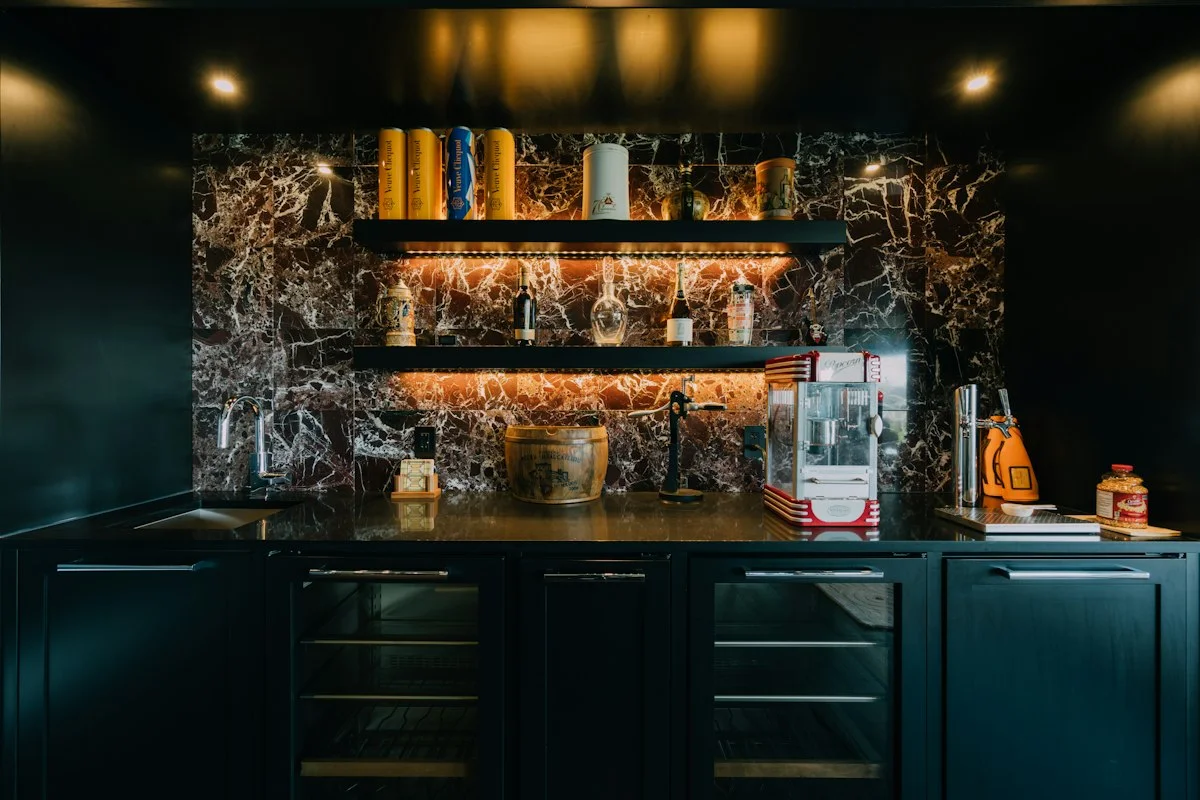

A bar cabinet shelf should hold the fully loaded weight of your bottles, glassware, and bar tools with a meaningful margin—not merely the weight of the bottles you own today. As a practical starting point, treat a dozen full 750-milliliter bottles as roughly 25–30 pounds, then add the weight of decanters, glasses, shakers, and other equipment. The exact limit still depends on the cabinet’s materials, shelf span, supports, hardware, and manufacturer rating.
If the cabinet does not provide a load rating, do not assume that a thick-looking shelf is strong enough. Inspect how the shelf is supported, keep the heaviest bottles low, distribute weight instead of concentrating it in the center, and stop using a shelf that bows, shifts, or pulls away from its supports.
Why liquor bottles put real demands on a shelf
A bar cabinet often looks like ordinary furniture, but bottles create a concentrated, uneven load. Glass bottles are heavy before they are filled, and spirits add substantial weight. A shelf holding several bottles in a row may also carry glassware, a cocktail shaker, an ice bucket, a decanter, and small tools.
The load is not always distributed perfectly. Bottles tend to be grouped together, often toward the front edge for easy access. That position increases the demand on the shelf and its supports. Repeatedly removing a bottle can also make a cabinet shift if it is tall, narrow, or not secured against tipping.
For comparison, a typical 24- to 36-inch wall-mounted liquor shelf may hold six to 12 standard bottles depending on its construction and installation. A larger, fully loaded bar shelf with 10 to 15 bottles, glassware, and accessories can reach approximately 40–65 pounds. Those figures are useful planning references, not universal ratings for every cabinet.
Estimate the weight of your collection
Start with the contents of one shelf rather than the entire cabinet.
A simple inventory method
- Count the full or partly full bottles assigned to the shelf.
- Note the bottle size and shape. Large-format bottles and heavy decorative bottles should be treated as heavier than standard bottles.
- Add the glassware stored on that shelf.
- Add decanters, shakers, bar tools, trays, and other accessories.
- Include a little room for future additions instead of loading the shelf to its apparent maximum.
A dozen standard 750-milliliter bottles may weigh about 25–30 pounds in total, according to the supplied storage guidance. A cabinet shelf with fewer bottles can still be heavily loaded if it also holds a thick decanter, large glasses, or metal barware.
If you need a more exact estimate, weigh a representative bottle and multiply by the number of similar bottles. A household scale can also help you weigh a box or tray of glassware. The goal is not laboratory precision; it is to avoid treating a shelf carrying 35 pounds as though it were carrying 15.
What determines a bar cabinet shelf weight limit?
The stated capacity is only meaningful when you understand what supports it.
Shelf material
Solid wood, plywood, metal, MDF, and particleboard behave differently under load. A shelf can be strong enough in one material and prone to sag in another, especially when it spans a wide opening without a center support. A decorative edge or thick front lip may improve stiffness, but appearance alone does not establish capacity.
Shelf span and depth
Longer shelves generally need more support than shorter shelves carrying the same weight. The center of a long shelf is the area most likely to sag. Depth also matters because bottles placed toward the front create leverage on the shelf and its supports.
Supports and hardware
Look for fixed shelf pins, a center divider, a continuous cleat, brackets, or another support that carries the shelf across more than just two small contact points. Adjustable pins can be useful, but they must fit tightly and be installed in matching holes at the same height.
For a wall-mounted cabinet or shelf, the mounting system and the wall structure are part of the load rating. A shelf attached only to drywall with ordinary plastic anchors should not be treated as equivalent to one secured to studs with an appropriate mounting system.
Cabinet stability
Shelf strength is only one part of the problem. A tall cabinet can tip even when an individual shelf has not failed. Check whether the cabinet has an anti-tip strap or another manufacturer-approved method of securing it to the wall. Follow the installation instructions for the specific piece rather than improvising hardware.
How to read a manufacturer’s rating
A manufacturer’s load rating is the best starting point because it should account for the cabinet’s construction and intended use. Before filling the cabinet, check the product manual, assembly instructions, product page, or a label inside the cabinet.
Look for these details:
- Whether the rating applies per shelf, per compartment, or to the entire cabinet
- Whether the stated capacity assumes evenly distributed weight
- Whether the rating applies to fixed shelves, adjustable shelves, or both
- Whether the cabinet must be anchored to a wall
- Whether the rating changes with shelf position or span
- Whether the rating is given for static storage only
Do not add the ratings of several shelves and assume that the cabinet as a whole can carry that total. The frame, base, fasteners, and anti-tip connection may have a lower limit than the individual shelves.
If no rating is available, contact the manufacturer before storing a large bottle collection. Ask specifically about the shelf material, maximum evenly distributed load, and whether the cabinet is intended for filled glass bottles. If the manufacturer cannot provide that information, use a conservative arrangement and choose a cabinet with clearer specifications for a substantial collection.
A practical pre-purchase checklist
Before buying a bar cabinet, inspect or confirm:
- A published shelf or cabinet load rating
- Shelf dimensions and the unsupported span
- Fixed shelves or substantial shelf supports
- A center divider or center support on long shelves
- Shelves made from a material suited to heavy storage
- Doors and hinges that do not interfere with bottle placement
- Enough vertical clearance for your tallest bottles
- A stable, level base
- An anti-tip provision for a tall or narrow cabinet
- Instructions for anchoring and assembly
- A return or warranty policy if the construction is unclear
A cabinet designed mainly for glassware and decoration may not be suitable for a collection of full spirits bottles, even if it is marketed as a bar cabinet.
How to load the cabinet safely
Put the heaviest bottles on the lowest shelf that can accommodate them, preferably near the cabinet’s sides or over a substantial support rather than concentrated at the unsupported center. Keep the load spread from left to right and front to back.
Use upper shelves for lighter glassware and small tools. Avoid stacking bottles unless the cabinet instructions specifically allow it. Leave enough space to remove a bottle without dragging several others forward. Recheck the shelf after loading: a visible dip, creaking, loose shelf pin, separating joint, or cabinet movement is a reason to unload it.
Keep the cabinet on a level surface. If it rocks, correct the installation rather than compensating by adding weight. For a tall cabinet, install the supplied anti-tip hardware according to the instructions.
Reinforcing bar cabinet shelves
Reinforcement can help, but it should not be used to turn an unsuitable cabinet into a heavy-duty storage system without understanding the load path. Useful approaches may include adding a properly fitted center support, replacing weak shelf pins with compatible higher-strength hardware, shortening the unsupported span, or replacing a thin shelf with a suitable panel.
Any replacement shelf must fit securely, remain level, clear the doors, and transfer its weight to supports designed for the cabinet. Screwing a brace into thin particleboard may not provide a reliable connection. If the cabinet is valuable, antique, unusually tall, or already damaged, consult a qualified cabinetmaker or furniture professional before modifying it.
The bottom line
There is no single universal bar cabinet weight limit. Start by estimating the actual load, then compare it with the manufacturer’s per-shelf and whole-cabinet ratings. Keep heavy bottles low and evenly distributed, use the supplied anti-tip hardware, and treat any sagging or movement as a warning—not as something the shelf will eventually “settle” through.
When the rating is missing or vague, the safer choice is to store fewer bottles, redistribute the collection, or select a cabinet built and documented for heavier loads.
Further reading
- How Much Weight Can a Bar Floating Shelf Hold? Exact Bottle Formula
- How Tall Should Bar Shelves Be? A Guide to Sizing
- Wall Mounted Liquor Shelf vs Bar Cabinet: Key Advantages